
Our Programs
Action for a Healthy Lake
Our work is focused on the most pressing environmental challenges facing Mirror Lake. Through monitoring, education, and community action, we tackle these issues head-on. Explore our key initiatives below to understand the threats and learn how you can become part of the solution.
Click to Learn More About Our Programs
Invasive Species Program
The Project consists of two parts:
- Educate the shoreline landowners and the general public about the threat, how to recognize and report invasive species, and about alternative non-invasive ornamental plants.
- Contain and/or eradicate the plant by assisting in: the inventorying and mapping of infestations, asking affected landowners for permission to remove vegetation, and the physical removal of plants.
Our Partners in this effort include:
Adirondack Park Invasive Plant Program
Hilary Oles, Program Coordinator
c/o Adirondack Nature Conservancy
Keene Valley, NY 12943
518 576-2082 x 131
Harmful Algal blooms (HABs), scientifically known as cyanobacteria or blue-green algae, are a type of bacteria found in most water bodies around the world. They play an important role in aquatic ecosystems, occasionally outcompeting other algae by using available nutrients more efficiently. Most cyanobacteria are microscopic and go unnoticed. Under certain conditions however, they can grow prolifically, forming unsightly and potentially toxic ‘blooms’ that can be extremely dangerous.
Cyanobacteria blooms may appear like thick pea soup, green paint, or grass clippings on the water. Although most of the cyanobacteria blooms that occur on lakes are harmless, cyanobacteria can sometimes produce toxins that can be dangerous if ingested in large enough quantities. These blooms can be dangerous to humans and lethal to dogs drinking from the water or licking their fur after a swim.
Harmful Algal Bloom Monitoring
Salt Pollution Reduction
Each winter, road salt (sodium chloride) helps keep our roads safe—but it also poses serious challenges for our environment, water quality, and even public health. When snow and ice melt, salt washes off roads and driveways into nearby soil, streams, and lakes. From there, it can linger for years, building up in our watershed.
The Mirror Lake Watershed Association works with local partners to reduce salt use while maintaining safe roads and walkways. By testing water quality, promoting salt alternatives, and sharing best practices with residents and municipalities, we can protect Mirror Lake for generations to come.
The Clean, Drain, Dry Initiative is one of the most important ways we protect Mirror Lake from aquatic invasive species. Each summer, trained lake stewards—through our partnership with the Adirondack Watershed Institute, the Village of Lake Placid, and the Town of North Elba—meet thousands of visitors at the public beach to share how simple steps like cleaning, draining, and drying boats can prevent harmful species from entering the lake. This daily, hands-on outreach helps keep Mirror Lake healthy by stopping invasives that could damage habitat, disrupt fish populations, and affect recreation and property values.
From Memorial Day to Labor Day, stewards inspected more than 2,500 watercraft and spoke with over 3,400 community members and visitors. Their work reinforces one of our core beliefs: education is the most powerful tool we have to protect Mirror Lake’s ecological health now and for the future.
Clean, Drain, Dry
Mill Pond Sediment & Sand Build-Up Initiative
Mill Pond is also an essential part of the MLWA focus on water quality, and rising concerns about sand buildup there have recently become a focus of our work. Sand from winter road maintenance and hillside runoff has created a growing delta in the pond, impacting water clarity, fish habitat, and shoreline ecology. The size and spread of this sediment mound is already supporting wetland vegetation—an indicator that the ecosystem is being altered.
The MLWA has been actively advocating for solutions, including more frequent clearing of stormwater structures and long-term upgrades to better manage winter runoff. We continue working closely with the Highway Department, the Village Board, and local residents to reduce further sediment accumulation and help restore the health of Mill Pond.
Frequently Asked Questions
If you see a Harmful Algae Bloom, (HAB) please call one of the following people. They will notify everyone on the list below.
- MLWA
- Nev Dunn
- 860-671-0733
- MLWA
- Steve Detwiler
- 518-570-7427
- AWI
- Dr. Brendan Wiltse
- 518-429-0049
- Village
- Anita Estling
- 518-523-2584
- Town
- Butch Martin
- 518-572-0027
- DEC
- Jeff Hovey
- 518-354-9014
- ROOST
- MJ Lawrence
- 518-637-7188
If a suspicious bloom is sighted:
- Please call one or more of the names above
- The first person on the scene will take pictures and note location (Lat & Lon)
- AWI will retrieve a sample or ask one of the above listed people to retrieve a sample to be delivered to AWI for testing. AWI will notify DEC. If for some reason AWI is unable to report to DEC, one of the above listed people will report to DEC: https://www.dec.ny.gov/chemical/83310.html
- ROOST will notify boat rentals and hotels
- Town will place warning signs at 8 public access points to the Lake when notified of the HAB by AWI or DEC.
- MLWA will post HAB alert on the MLWA Instagram site, website and with the LP News
- AWI and MLWA will continue to monitor the status of the HAB
- The Town will retrieve signs one week after the time no HAB is apparent.
MLWA meets every 2nd Monday of each month at 5 PM at the public beach house, on the second floor and you are welcome to attend and participate in our meeting. Enter on the west side off of Park Ave.
The cost to do all these projects is both human and monetary.
Come to the meetings, offer suggestions, and give support. These meetings are open to public. and we encourage you to join us.
Everything Must Go Somewhere!
Mirror Lake receives pollutants from a lot of human and animal activity.
The urban nature of much of the watershed, the proximity of roads and buildings to the lake, and the steepness of the natural grade dictate that storm run off goes quickly and forcefully into Mirror Lake.
Automobile related pollutants such as oil, gasoline and coolants are clear threats to water quality. And it’s not just cars that can put debris on our sidewalks and streets. Anything that can float will flush to our lake.
Winter road salt and sand create an enormous problem for Mirror Lake. (Recently installed catch basins and filters will help greatly). The salt flushes quickly into the lake. The sand creates alluvial fans of siltation at the outlets of storm drains.
The bacteria and parasites associated with animal wastes from pets and ducks can create water quality problems particularly for swimmers.
Even gardening activities can have a negative impact on water quality if fertilizers and other chemicals are inappropriately applied.
A land area that contributes water, through run-off or subsurface infiltration and flow to a given point of drainage. A watershed is usually considered to be smaller than a basin. Smaller, contributory watersheds or subsurface watersheds, usually range from 12 to 15 square miles in size.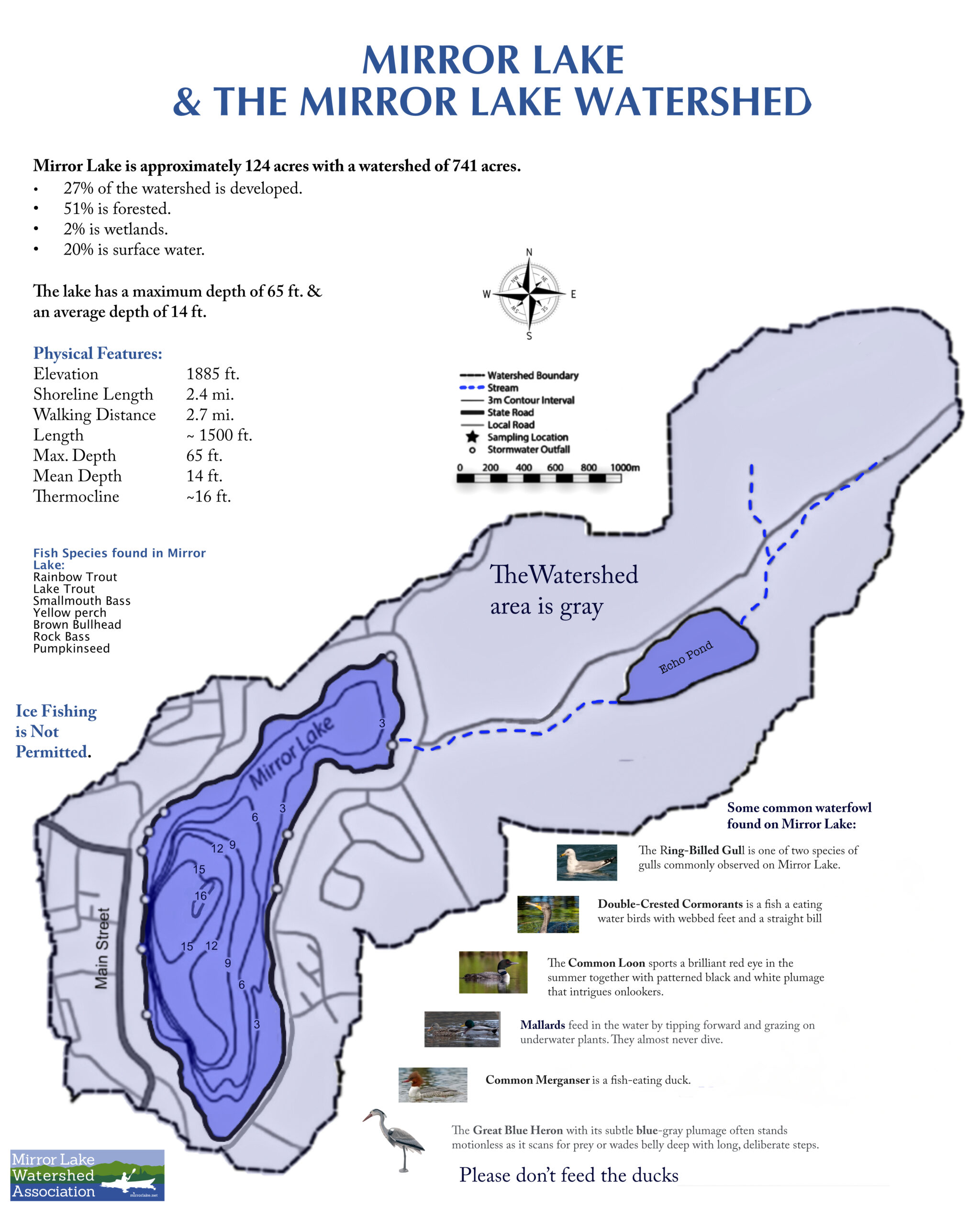
Mirror Lake drains to the Chubb River, then to the West Branch of the Ausable River, and on to Lake Champlain.
The Mirror Lake watershed can be described as having two very different parts. The first lies to the northeast of the lake and is characterized by heavily forested land, permeable surfaces, and a system of ponds and streams that help filter and slow drainage.
One part is urban and residential characterized by density of development and a high degree of impermeable surfaces. These characteristics are complicated by the steepness of the topography in much of the watershed. Mirror Lake’s outlet is at the southern end close to the municipal beach.
The urban/residential part of the watershed can be viewed as having three different categories of storm water impacts. The Mirror Lake Storm Water Action Plan of 2001 describes these as high density commercial, low density commercial, and residential.